Civ 7's Redemption Arc: How Firaxis Is Finally Fixing Everything
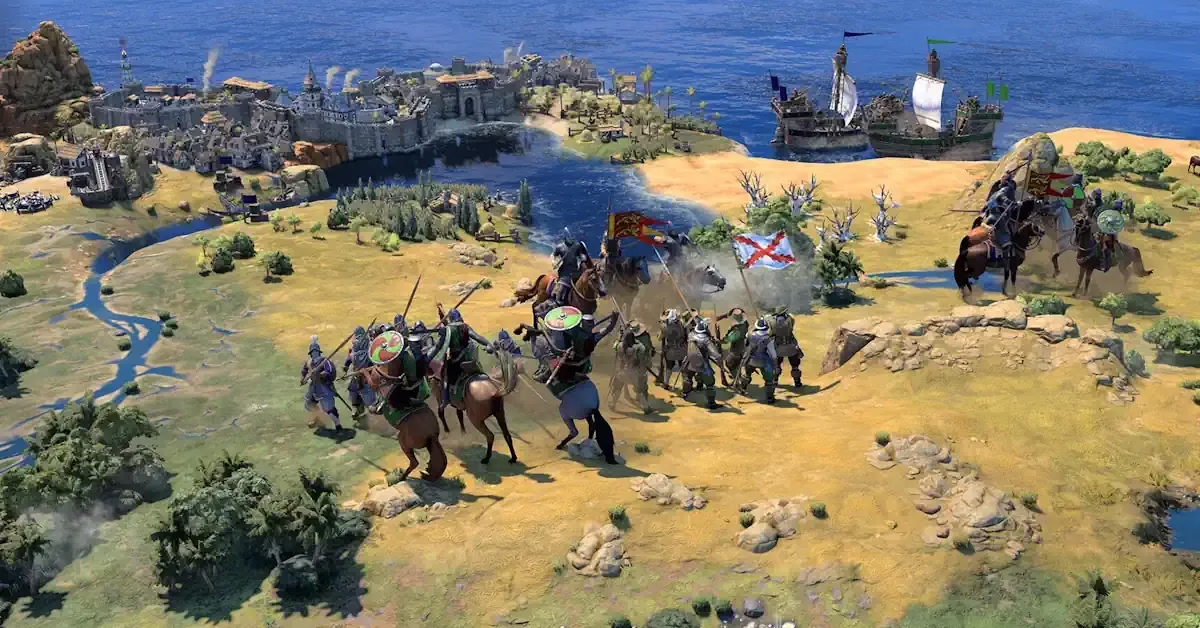
I'll admit it—when Civilization VII dropped last February, I was pumped. But that excitement quickly turned into frustration, and honestly, I wasn't alone. The Steam reviews sitting at "mixed" weren't just noise; they were a collective cry from a community that felt betrayed by a game that tried too hard to innovate and ended up breaking what made Civ... well, Civ. But here's the thing: Firaxis isn't ghosting us. They're actually rolling up their sleeves and dropping some serious fixes that tackle the elephant in the room—or should I say, the broken Age system in the game.
The Band-Aid: Update 1.3.2 Drops Now
Before we dive into the game-changing stuff coming this Spring, let's talk about what's hitting our screens right now. Update 1.3.2 just went live, and it's basically Firaxis saying, "We hear you, and we're working on it." The big headline? Gilgamesh is back, baby! And he's free for everyone. Sure, the "Gilbro" memes are fun and all, but this patch is about way more than just bringing back our favorite ancient bromance simulator.
Here's what actually matters: nested tooltips in the Tech & Civics trees. I know, I know—it sounds like the most boring patch note ever written. But trust me, if you've played Civ 7, you know the pain of clicking back and forth seventeen times just to figure out what the hell a building actually does. No more alt-tabbing to a wiki every five seconds. This is peak quality-of-life improvement, and it's about damn time.
They've also thrown in a new Appeal Lens, which is clutch for those of us who actually care about tile yields and Happiness bonuses. Now you can finally see at a glance which tiles are "Breathtaking" without squinting at tiny numbers. Plus, they've tweaked the balance for France, Dai Viet, and the Mughals—because apparently, some Civs were either OP or completely useless. Classic Civ balance issues, am I right?
The Main Event: "Test of Time" Update Coming Spring
Alright, let's cut to the chase. The "Test of Time" update dropping this Spring is where Firaxis is really putting their money where their mouth is. This isn't just a patch; it's a complete overhaul of the game's most controversial mechanic: the Age system.
The Age System: What Went Wrong
When Civ 7 launched, the biggest complaint—and I mean the biggest—was being forced to switch Civilizations every single era. Imagine this: you spend hours building Rome into a powerhouse, conquering neighbors, developing culture, perfecting your strategy... and then BAM, you're suddenly not Rome anymore. You're forced to pick a new Civ and start fresh-ish. It was like getting halfway through a great movie and someone switching it to a completely different film. The immersion? Shattered.
The core fantasy of Civilization has always been about building your empire, watching it grow from the Ancient Era all the way to the Space Age. Being forced to abandon your identity every few hundred turns? That's not strategy; that's an identity crisis with extra steps.
Enter the "Apex Age" Mechanic
Fireaxis heard the outcry, and they're introducing something that might actually save this game: the Apex Age mechanic. Here's how it works, and why it's brilliant:
-
You can now stick with your starting Civ through the entire game. Want to play as Rome from 4000 BCE to the year 2050? Go for it. No forced swaps.
-
When you play a Civ outside its historical "Apex" period (like Rome in the Modern Age), you use a new system called Syncretism.
-
Syncretism lets you "borrow" unique units, buildings, or techs from other Civs to stay competitive, while still keeping your Roman identity, flag, and leader.
It's honestly the best of both worlds. You get the strategic flexibility and variety that Firaxis wanted to introduce with the original Age system, but without the jarring, immersion-breaking forced swaps. You're still Rome. You're just... adapted Rome. Think of it like how the real Roman Empire evolved over centuries, absorbing cultures and technologies while still being fundamentally Roman.
Triumphs Replace Legacy Paths: Freedom to Win Your Way
The other massive issue at launch was how rigid the victory conditions felt. The Legacy Paths were too linear, basically forcing you into a specific playstyle way too early. If you picked a Military path in the Ancient Era, you were locked into warmongering for the rest of the game, even if diplomacy or culture made more sense later. It felt like the game was playing itself, and I was just along for the ride. Not exactly engaging, you feel me?
Fireaxis is scrapping Legacy Paths entirely and replacing them with Triumphs. This new system is way more organic and flexible:
-
You can now chase victory through Military, Economy, Culture, or Science dominance at your own pace.
-
If you're absolutely crushing it, you can trigger a win condition as early as the Exploration Age. No more slogging through 200 pointless turns when you've clearly already won.
-
The mid-game actually matters now. It's not just a boring bridge between the Ancient and Modern eras.
This change alone makes the game feel less like you're on rails and more like you're actually making meaningful strategic decisions. The flexibility means you can pivot your strategy based on how the game unfolds, not based on a decision you made in turn 50.
Should You Give Civ 7 Another Shot?
Look, I get it. If you refunded the game back in February or held off buying it because of the reviews, you were probably smart. The launch version of Civ 7 was... let's call it "half-baked." But here's my take: wait for the Spring update.
Update 1.3.2 is nice—free Gilgamesh, better tooltips, quality-of-life improvements—but it's not the game-changer. The "Test of Time" update coming this Spring? That's the real deal. That's the patch that fixes the fundamental design flaws that made launch Civ 7 feel like a beautiful mess.
What the "Complete Experience" Looks Like
With the Apex Age system and Triumphs in place, Civ 7 is finally shaping up to be the game Firaxis probably envisioned from the start. You get:
✅ The flexibility to stick with your chosen Civ the entire game
✅ Strategic variety through Syncretism without losing your identity
✅ Organic, player-driven victory conditions through Triumphs
✅ A mid-game that's actually engaging instead of a glorified waiting room
✅ Quality-of-life improvements that make the game playable without a PhD in Civ-ology
It's honestly wild that it took a full year to get here, but credit where it's due: Firaxis is actually listening and making the hard changes. This isn't just slapping a bandaid on a broken system; they're performing surgery.
The Bottom Line
Civilization VII's first year has been rough, no question. The launch felt like a beta test disguised as a full release, and the community had every right to be frustrated. But Firaxis is putting in the work. The "Test of Time" update coming this Spring looks like it could finally deliver the Civ experience we all wanted from day one.
If you're on the fence about giving Civ 7 another chance, my advice? Hold tight until Spring. Let Firaxis finish what they started. The game you probably wanted to play back in February is finally taking shape, and honestly? I'm cautiously optimistic. The Apex Age and Triumphs systems address the core problems head-on, and if they nail the execution, Civ 7 could go from "mixed" to "must-play."
Of course, the big question remains: Are you willing to give Civ 7 a second chance, or did Humankind already steal your heart? Personally, I'm ready to boot up Rome one more time and actually get to stay Roman for the entire game. That alone might be worth the price of admission.
Now if you'll excuse me, I've got a Gilgamesh playthrough calling my name. Time to see if the "Gilbro" lives up to the hype. 🎮
