Overwatch Rush: A Strategic Mobile Evolution
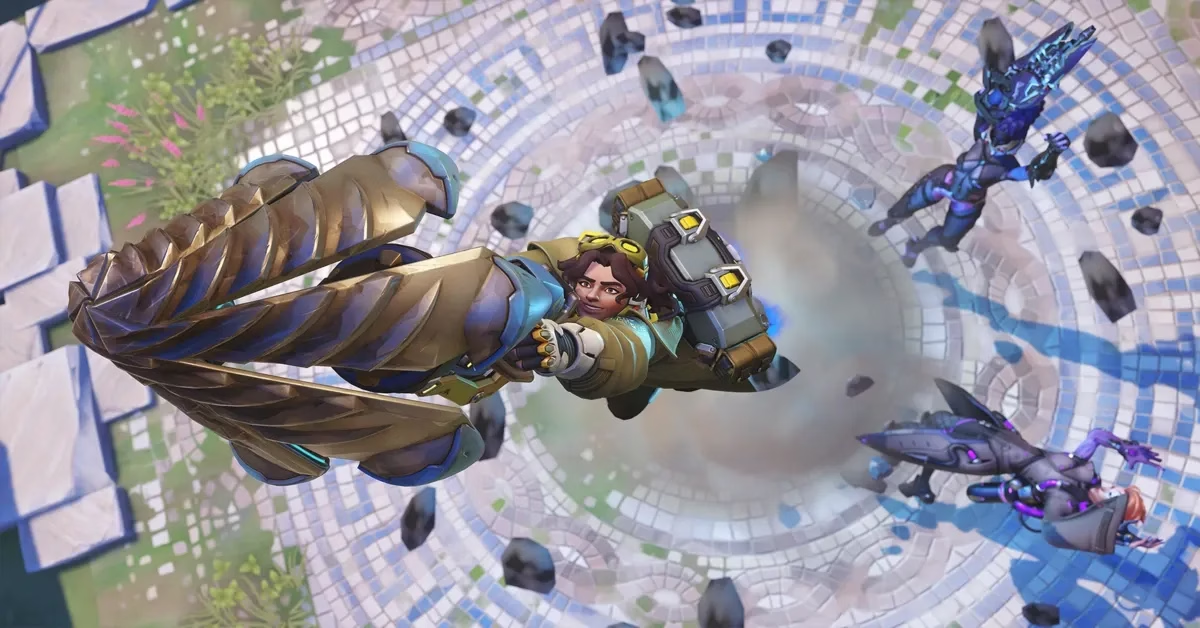
The world of competitive hero shooters was about to witness an unexpected transformation. In 2026, Blizzard Entertainment unveiled a project that would challenge everything players thought they knew about the Overwatch franchise. This wasn't just another mobile port—it was a complete reimagining of the beloved hero-based combat system that had captivated millions worldwide.
🎮 The Birth of a New Battlefield
When Blizzard first announced Overwatch Rush through their official blog channels, the gaming community found themselves standing at a crossroads. The studio had assembled a specialized mobile development team with a singular mission: to create an experience that would honor the franchise's legacy while embracing the unique possibilities of mobile gaming. Gone would be the familiar first-person perspective that had defined the series since its inception. In its place emerged a tactical, top-down view that promised to emphasize strategic depth over raw mechanical skill.
The transformation from the traditional 5v5 format to a more intimate 4v4 structure represented more than just a numerical change. Every engagement would now carry different weight, every hero selection would matter more profoundly, and every tactical decision would ripple through the reduced team size with amplified consequences. The mathematics of combat had been fundamentally altered, creating a game where positioning and prediction would triumph over split-second reflexes.
🏗️ Building a Mobile-First Experience
The development philosophy behind Overwatch Rush stood in stark contrast to the typical mobile adaptation approach. Rather than simply shrinking down existing assets and mechanics, the team committed themselves to creating something that felt native to touchscreen devices. Every system, every control scheme, every visual element was being constructed with mobile hardware in mind from the very beginning.
Key Design Innovations
| Feature | Traditional Overwatch | Overwatch Rush |
|---|---|---|
| Perspective | First-Person Shooter | Top-Down Tactical |
| Team Size | 5v5 | 4v4 |
| Control Method | Mouse/Keyboard or Controller | Touch-Optimized |
| Pace | Rapid Twitch-Based | Strategic Positioning |
| Verticality | Free Movement | Ability-Prompted |
The handling of verticality proved particularly ingenious. In the original Overwatch games, vertical movement required precise aiming and spatial awareness that translated poorly to mobile platforms. The Rush development team solved this challenge by integrating vertical options directly into character abilities, presenting them through intuitive prompts rather than demanding free-aim precision. This solution preserved the franchise's signature three-dimensional combat while maintaining the tactical flow essential to mobile gameplay.
📱 A Philosophy of Transparency
Blizzard's approach to revealing Overwatch Rush marked a departure from industry standard practices. Rather than unveiling the project with a polished cinematic trailer filled with scripted moments and perfect gameplay sequences, they chose radical transparency. The initial footage showcased an actual developer playtest, complete with all the rough edges and unfinished elements that typically remain hidden until much later in development.
This decision carried significant implications for the relationship between developers and players. By labeling this announcement as coming from the "early days" of development, Blizzard set expectations appropriately while simultaneously inviting the community into the creative process. They weren't presenting a finished product for approval—they were opening a conversation about what this mobile experience should become.
🔧 The Dynamic Development Process
The studio's commitment to community involvement went beyond mere lip service. They established an official Discord server specifically for Overwatch Rush, creating a direct channel between developers and players. This platform would serve as more than just a feedback collection point; it represented the foundation of a collaborative development approach where player voices would actively shape the final product.
Development Priorities Under Consideration:
-
⚔️ Hero Roster Expansion: The initial launch roster of eight heroes provided a foundation, but community input would help determine which additional characters should join the mobile battlefield first
-
⚖️ Tactical Balance Refinement: The 4v4 format created new balance considerations that would require extensive testing and adjustment based on player experience
-
🎯 Ability Adaptation: Determining which franchise abilities translated well to mobile controls and which required complete redesigns
-
🗺️ Map Design Philosophy: Creating battlefields that supported the top-down perspective while maintaining the environmental diversity Overwatch was known for
The promise of regular updates throughout development meant that players wouldn't simply wait in darkness for a finished product. Instead, they would witness the game's evolution, potentially participating in regional testing phases that would roll out across select countries before a global launch.
🌟 Strategic Depth Over Chaotic Action
The shift from chaotic flick-shots to calculated positioning fundamentally altered what it meant to excel at Overwatch. In the traditional first-person format, success often hinged on mechanical skill—the ability to track targets, land precision shots under pressure, and react with split-second timing to threats emerging from any angle. Overwatch Rush would reward different virtues: spatial awareness, team coordination, resource management, and tactical foresight.
Players accustomed to carrying games through individual mechanical prowess would need to adapt to an environment where teamwork and strategic thinking took precedence. The slower pace didn't mean less intensity—it meant intensity of a different kind, where every movement was deliberate and every decision carried weight that couldn't be undone through quick reflexes alone.
🎭 Following the Reign of Talon
The timing of Overwatch Rush's announcement proved particularly significant. The franchise had recently experienced a revitalization through the "Season 1" relaunch and the subsequent "Reign of Talon" update, which had injected fresh energy into the community. Player engagement had climbed, streaming numbers had improved, and the competitive scene felt more vibrant than it had in years.
Overwatch Rush wasn't attempting to cannibalize this renewed success. The development team made clear their intention wasn't to replace the core Overwatch experience that players loved, but rather to expand the universe into new territory. They were carving out a space in the rapidly growing mobile esports scene, where games like PUBG Mobile and Call of Duty Mobile had already demonstrated that competitive shooters could thrive on smartphones and tablets.
📊 The Mobile Esports Landscape
By 2026, mobile gaming had evolved far beyond its casual origins. Professional mobile esports tournaments offered prize pools rivaling traditional PC and console competitions. Teams maintained dedicated mobile rosters, sponsors invested heavily in the space, and millions of viewers tuned in to watch top-tier mobile competitions.
Overwatch Rush entered this landscape with significant advantages:
-
🏆 Established IP Recognition: The Overwatch brand carried enormous weight, promising instant visibility in a crowded market
-
🎨 Distinctive Art Style: The franchise's iconic character designs and vibrant aesthetic would help it stand out among more realistic military shooters
-
🤝 Built-in Community: Millions of existing Overwatch fans represented a ready-made audience eager to engage with a mobile version
-
💪 Blizzard's Development Expertise: The studio's reputation for polish and support provided confidence that Overwatch Rush would receive long-term investment
🔮 The Path Forward
As regional testing phases approached, the Overwatch community found itself in an unusual position. They weren't simply waiting to play a new game—they were participating in its creation. The Discord server buzzed with discussions about which heroes should make the jump to mobile first, how abilities might be adapted, what new mechanics might emerge from the format change.
Some veterans expressed skepticism about whether the essence of Overwatch could survive such a dramatic transformation. Could the game's magic—the thrill of a perfectly timed ultimate, the satisfaction of a well-coordinated team push, the diversity of playstyles across its hero roster—translate to a top-down mobile experience? Others saw opportunity in the unknown, excited to discover whether strategic depth might reveal new dimensions of the franchise they hadn't previously considered.
🎯 A Calculated Expansion
What became clear through Blizzard's messaging and approach was that Overwatch Rush represented a calculated, thoughtful expansion rather than a rushed cash grab. The dedicated mobile team, the commitment to transparency, the emphasis on community feedback, the acknowledgment that this was early-stage development—all these factors suggested a studio taking the mobile space seriously.
In an era where beloved franchises often received low-effort mobile adaptations designed purely for monetization, Overwatch Rush appeared to be aiming higher. Whether it would successfully capture the franchise's competitive spirit in a mobile package remained to be seen, but the foundation being laid suggested Blizzard understood the challenge ahead.
🌈 Conclusion: A Universe Expanded
As 2026 progressed, Overwatch Rush stood as more than just another mobile game announcement. It represented a studio willing to experiment with its most valuable properties, a community invited to help shape that experimentation, and a franchise confident enough in its core identity to explore radically different expressions of that identity.
The journey from announcement to regional testing to eventual global launch would undoubtedly present challenges. Balancing eight heroes for 4v4 tactical combat would prove complex enough; expanding that roster while maintaining competitive integrity would demand constant attention and adjustment. Creating maps that supported strategic depth in a top-down perspective while remaining accessible to mobile players would test the design team's creativity.
Yet for players who had followed Overwatch through its original launch, its transition to Overwatch 2, its struggles and successes, its evolving meta and shifting community dynamics, Overwatch Rush offered something refreshing: the chance to experience a beloved universe from an entirely new angle. Whether that new perspective would prove as compelling as the original remained one of 2026's most intriguing questions in gaming.
For now, the Discord server continued to fill with theories, suggestions, and anticipation. Regional testing loomed on the horizon. And somewhere at Blizzard, a dedicated mobile team worked to prove that the magic of hero-based synergy could not only survive a radical perspective shift—it could thrive in ways no one had previously imagined. 🚀
