Ready or Not Controversy Sparks 200% Player Surge
When Controversy Becomes Marketing Gold 💥
Something unexpected happened in the gaming world recently. Ready or Not, the hardcore tactical shooter that puts players in SWAT boots, found itself drowning in negative Steam reviews. Yet somehow, player counts exploded—more than doubling overnight. The gaming community has seen this pattern before, but rarely at this scale.
The drama started when developer Void Interactive announced their plans to adjust certain content for the upcoming console launch. These changes weren't just for PlayStation 5 and Xbox Series X|S versions though—they'd apply across all platforms, including PC. The decision triggered what gamers call a "review bombing," where thousands of players flood a game's page with negative feedback.
The Numbers Tell a Different Story 📊
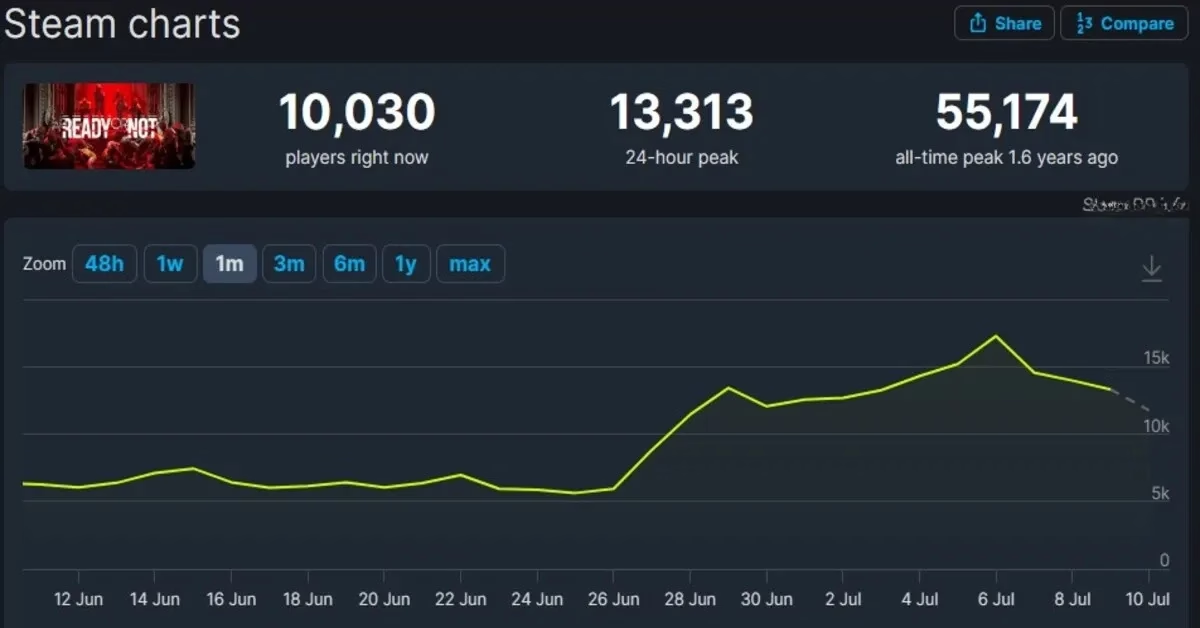
Here's where things get interesting. Over the past 30 days, Ready or Not received approximately 19,000 reviews. Of these, only 23% carried positive ratings—an objectively terrible score by any metric. Most developers would panic seeing those numbers. But Void Interactive probably noticed something else in their analytics dashboard: concurrent player counts jumping from a steady 5,000-6,000 to peaks between 12,000 and 16,000.
| Metric | Before Controversy | During Controversy | Change |
|---|---|---|---|
| Concurrent Players | 5,000-6,000 | 12,000-16,000 | +200% |
| Review Score (30 days) | N/A | 23% Positive | N/A |
| Total Recent Reviews | N/A | ~19,000 | N/A |
That's not a small bump—we're talking about a 200% increase in people actually playing the game. While keyboard warriors typed angry reviews, thousands of curious gamers were downloading and experiencing the title firsthand.
Perfect Storm of Circumstances ⛈️
The controversy alone doesn't explain everything. Timing played a crucial role here, because—wouldn't you know it—Steam's Summer Sale happened to coincide with the review bombing. The game's price dropped from roughly €50 to around €25, effectively cutting the barrier to entry in half.
Think about it from a casual gamer's perspective:
-
Everyone's talking about this controversial tactical shooter
-
Reviews are mixed, sure, but people are definitely paying attention
-
The game suddenly costs half price
-
There's genuine curiosity about what all the fuss is about
For many potential players, that combination proved irresistible. The negative publicity essentially functioned as free advertising, while the discount removed financial hesitation. Pretty clever, even if Void Interactive didn't necessarily plan it that way! 😏
Console Launch on the Horizon 🎮
Ready or Not officially lands on PlayStation 5 and Xbox Series X|S on July 15, 2025—just days away as of this writing. The pre-order numbers already tell an encouraging story. On PlayStation's digital storefront, the game climbed to second place among top titles before even launching. That's impressive positioning for a title that built its reputation primarily on PC.
Void Interactive made an interesting strategic choice regarding platform parity. Rather than maintaining separate versions with different content, they opted to keep console and PC experiences identical. Their reasoning? Technical consistency and reduced development overhead. Makes sense from a business perspective—maintaining multiple content versions creates ongoing work and potential for platform-specific bugs.
What Makes Ready or Not Special? 🎯
For those unfamiliar, Ready or Not positions itself as an authentic SWAT simulation. We're not talking about arcade-style shooters where health regenerates and players respawn endlessly. This game demands:
-
Tactical Planning: Rushing in gets you killed quickly
-
Team Coordination: Solo heroics typically end badly
-
Realistic Mechanics: Weapons behave like their real-world counterparts
-
Consequence Management: Every decision matters, every shot counts
-
Mission Variety: Different scenarios require different approaches
The game fills a specific niche that larger studios have largely abandoned. Where mainstream shooters chase broader audiences with accessible gameplay, Ready or Not targets players who want something genuinely challenging and immersive. That dedicated fanbase explains both the passionate negative reactions and the sustained player interest.
The Psychology Behind Review Bombing 🧠
Review bombing presents a fascinating social phenomenon in gaming. Passionate players express displeasure by coordinating negative reviews, hoping to pressure developers into reversing decisions. Sometimes it works. Sometimes it doesn't. But almost always, it generates massive visibility.
In Ready or Not's case, the bombing achieved something unintended: mainstream gaming news coverage, social media discussion threads, YouTube analysis videos, and Twitch streams all examining the controversy. Each piece of content represented free marketing reaching potential customers who'd never heard of the game.
Many of these newcomers probably thought: "A realistic tactical shooter? With actual controversy? For 50% off? Let me check this out." And just like that, Void Interactive gained thousands of new players despite—or perhaps because of—the coordinated negative feedback.
Looking Toward the Future 🔮
The real question now becomes sustainability. Sure, controversy and discounts drove impressive short-term growth. But will these new players stick around? Several factors will determine Ready or Not's long-term trajectory:
Content Updates: Regular new missions and features keep communities engaged
Community Management: How Void Interactive communicates moving forward matters enormously
Gameplay Balance: Addressing legitimate player concerns while maintaining the core experience
Console Performance: The July 15 launch needs to go smoothly to retain console players
Modding Support: PC gaming communities thrive when given creative tools
Early 2026 will reveal whether this surge represents a permanent expansion of Ready or Not's player base or just a temporary spike. Games have bounced back from worse situations, and they've also squandered golden opportunities.
Lessons for the Industry 💡
Ready or Not's situation offers several takeaways for developers and publishers:
-
Negative attention beats no attention: Being talked about, even controversially, drives discovery
-
Price matters: Strategic discounting during visibility spikes maximizes conversion
-
Player actions ≠ player words: Review scores don't always predict commercial performance
-
Niche audiences are valuable: Serving underserved genres can build passionate communities
-
Controversy requires careful handling: How developers respond shapes long-term reputation
The gaming industry often treats review scores as gospel, but Ready or Not demonstrates the limitations of that thinking. Thousands of players who might never have discovered the game now own it, and many are likely enjoying the experience despite the negative reviews.
The Bottom Line 💰
Ready or Not's recent experience proves that the relationship between public perception and commercial success isn't always straightforward. A game can receive substantial criticism while simultaneously experiencing explosive growth. Controversy generated visibility, discounts removed barriers, and curiosity drove thousands of new players to try the experience themselves.
As the console launch approaches, Void Interactive finds itself in an enviable position: dramatically increased player counts, strong pre-order performance, and mainstream attention their marketing budget probably couldn't have bought. Whether they capitalize on this momentum depends entirely on execution from here forward.
For now though, Ready or Not stands as a fascinating case study in how negative publicity, when combined with the right circumstances, can paradoxically fuel success. The gaming community's relationship with controversy remains complicated, unpredictable, and apparently quite profitable—at least in this particular instance! 🚀
What happens next will determine whether this marks a turning point for the game or just a memorable moment in its development journey. But one thing's certain: way more people are paying attention now than they were a month ago, and in the attention economy, that's half the battle won.
